

Root cause: why is the B2B consideration cycle so long?
Unlike retail or recurring products, where consideration is settled in hours or days, buying heavy industrial equipment or medical machines takes months to years.
| Parameter | Retail / Recurring Product | Technical B2B Product (Factory / Medical Machine) |
|---|---|---|
| Consideration length | Short (minutes to days) | Long (months to years) |
| Purchase risk | Low (impulsive / cheap) | Very high (large capital investment / operational chain) |
| Decision maker | Individual (single buyer) | Multiple (Decision Maker + User + Finance) |
| Evaluation focus | Emotion, convenience, or low price | ROI, operational efficiency, reliability, & revenue |
This long process happens because of cognitive friction, and a real clash of interests inside the buyer's own organization:
- The technical team (user): afraid the machine won't match the needed specification, will be hard to operate, will break down often, or that instead of making daily work easier it will make it harder.
- The decision maker (non-technical): afraid of misallocating capital, slowing down the payback period, or failing to generate additional revenue.
Two case studies and realistic analogies
1. The factory machine analogy (manufacturing & automated packaging)
Scenario: a food manufacturing company wants to buy a robotic-arm-based automated packaging system priced at Rp 3 billion.
- Common mistake (technical approach): the sales team presents that the machine uses a 5kW servo motor, 0.01mm precision transmission, and an EtherCAT-protocol PLC controller.
- The CFO's response (non-technical): loses focus because the jargon means nothing to them, and postpones the purchase decision.
The business approach — removing the friction:
- To the user (plant manager): "This machine cuts weekly maintenance from 6 hours to 30 minutes, and the system is anti-jamming."
- To the decision maker (director): "This Rp 3 billion investment raises output capacity by 40% without adding a work shift, so it pays back in roughly 14 months."
2. The hospital equipment analogy (advanced CT-scan / MRI)
Scenario: a private hospital is considering a high-end 3.0 Tesla MRI unit priced at Rp 25 billion.
- Common mistake (technical approach): explaining Tesla magnetic field strength, the liquid helium cooling system, and gradient coil slew rate.
- The hospital owner/director's response (non-technical): worried the investment is too large and unsure whether it will generate returns or become an operational burden.
The business approach — removing the friction:
- To the user (radiologist & radiographer): "Image quality is far sharper for complex cases, with a 30% faster scan time per patient."
- To the decision maker (hospital owner / board): "With faster scan times, your hospital can serve up to 8 additional patients a day. Within 3 years, the extra cash flow from scans doesn't just cover the purchase — it becomes the radiology unit's leading source of profit."
Mind map: the prep flow for marketing a technical product
To win a long B2B consideration process, here's the framework a marketing and sales team needs to prepare — starting from one root task, splitting into two tracks, and converging on the channel architecture:
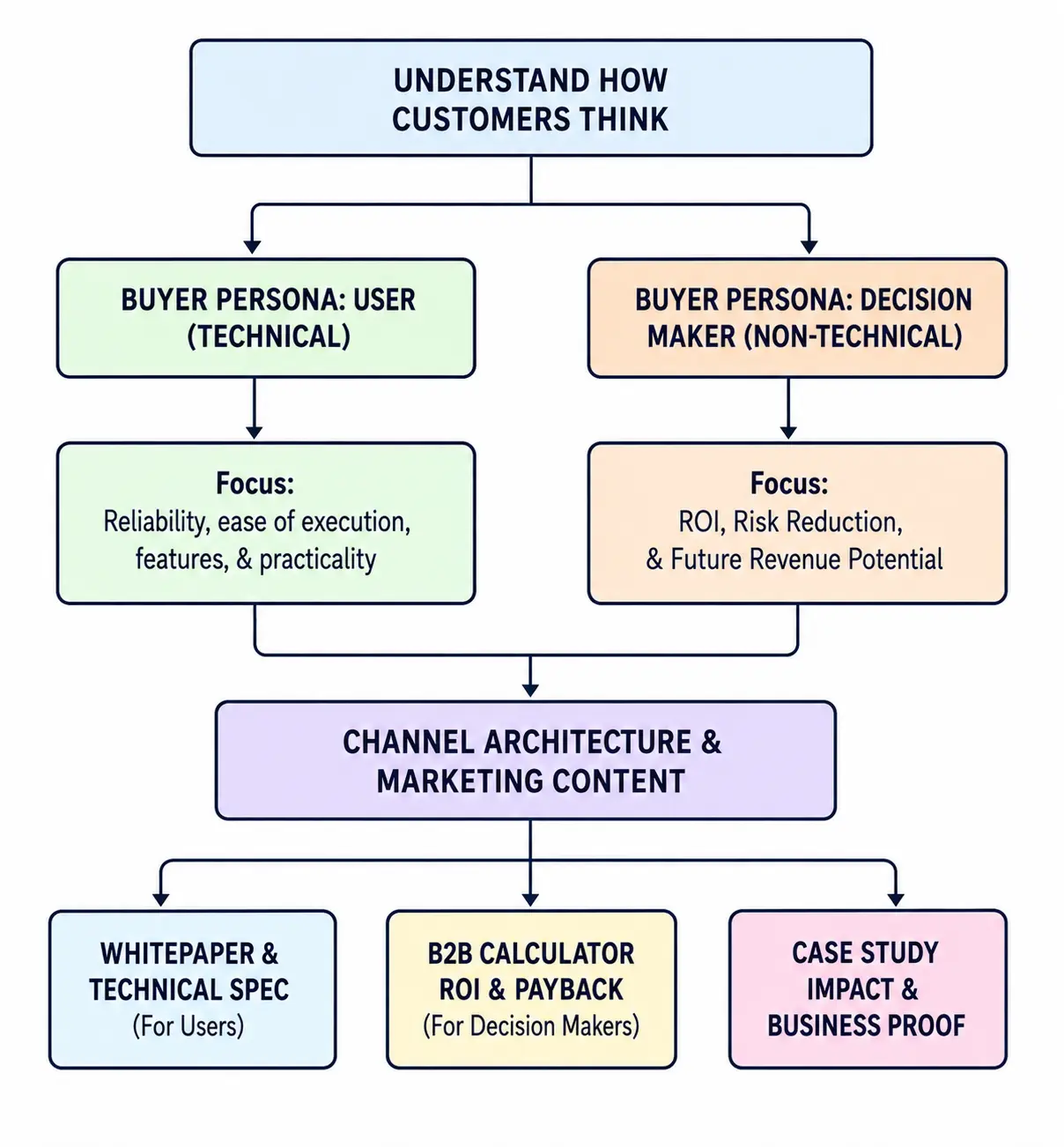
Strategic prep steps
- Diagnose the buying blocker: find out whether the block sits in the operational team's technical fears, or management's financial doubts.
- Split your communication assets: build a dedicated technical spec document for the user, and a financial/ROI-projection executive summary for the decision maker.
- Build proof of revenue: provide real case studies from similar industries proving how the machine helped add or save revenue.
How Orelux helps market your technical B2B product
At Orelux, we believe digital channels — SEO, social media, paid traffic — are just tools. What actually decides a B2B win is how well you understand your prospect's thinking and remove the cognitive friction in their decision-making flow.
Selling industrial machines or medical devices without the right message architecture just burns marketing budget and stretches out the sales cycle.
Through Orelux's Strategy & Digital Presence service, we help you design a solid B2B marketing ecosystem:
- Low-friction website & landing page development: building a B2B site structured around modern AEO/GEO formatting, separating the information path for the technical team (user) from the investment narrative for the decision maker.
- Channel architecture & B2B marketing strategy design: mapping the B2B customer journey from Discovery, through building Trust, to a clearer Consideration stage and conversion.
- Value narrative & positioning: turning complex technical messaging into a business value proposition that a board of directors or investors can grasp immediately.
Source: Orelux Business Insight — Understand the Customer.